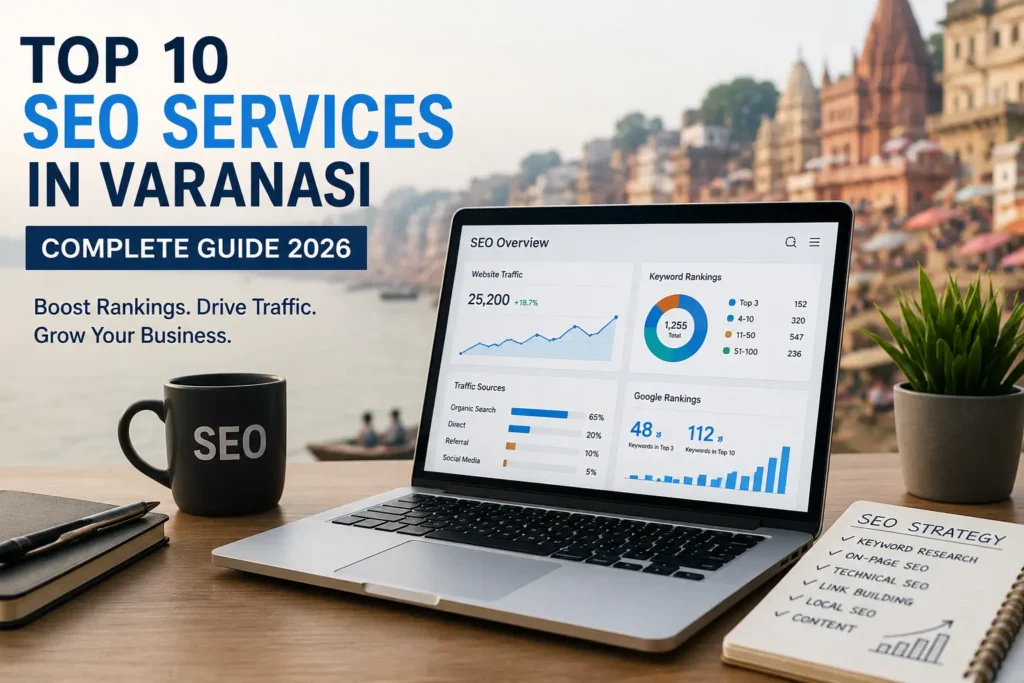
Digital Marketing Strategy Hotels & Restaurants
Varanasi is not a small town anymore. It is one of the fastest growing tourism and pilgrimage hubs in North India, and every year lakhs of visitors come here — for the Ganga Aarti, for the ghats, for weddings, for business, and simply to experience the city. This means one thing for every hotel owner, restaurant owner and hospitality business in this city: the competition for customers has moved online.
If you own a hotel near Assi Ghat, a restaurant near Godowlia, or a homestay close to BHU, your next guest is not walking past your gate first. They are searching on Google, checking your reviews, comparing your menu photos, and deciding before they even step out of their house or hotel room. This is exactly why a proper digital marketing strategy for hotels and restaurants in Varanasi is no longer optional — it is the difference between a fully booked weekend and empty tables.
In this guide, I am going to walk you through everything I have learned from working with small businesses, restaurants, and hospitality brands over the years — what actually works, what wastes money, and how you can build a strategy that brings real bookings, not just likes and followers. This is written in simple language, without heavy jargon, because that is what actually helps a business owner take action.
By the end of this article, you will understand how to build a mobile friendly website, rank locally, get more genuine customer reviews, use schema markup properly, and turn Google searches into paying customers.
Why You Need a Digital Marketing Strategy for Hotels and Restaurants
A few years back, a good location and word of mouth were enough. A hotel near the railway station or a restaurant near a temple could survive purely on foot traffic. That is changing fast.
Here is what is actually happening in Varanasi right now:
- Tourists are booking hotels 2-3 weeks in advance using Google Search and OTA apps, and they check reviews before confirming.
- Local families are searching “best restaurant near me” or “banquet hall in Varanasi” on their phones before stepping out.
- Wedding planners and corporate travellers search Google Maps first, not local directories.
- Students and working professionals near BHU and Sigra area order food online almost daily.
- Even pilgrims visiting for Kashi Vishwanath temple check hotel photos and reviews before booking a room.
This shift means your business needs to be visible at the exact moment someone is searching. That is what a proper digital marketing strategy does — it puts your hotel or restaurant in front of the right person, at the right time, with the right message.
I have seen small restaurants in Varanasi go from half-empty on weekdays to fully booked simply by fixing their Google Business Profile and getting genuine reviews. It is not magic, it is just doing the basics correctly and consistently — which is exactly what a good digital marketing strategy for hotels and restaurants is built on.
Understanding Search Intent Before You Market
Before spending a single rupee on marketing, you need to understand search intent — this simply means understanding why someone is searching for something.
There are three types of search intent that matter for hotels and restaurants:
1. Informational Intent
The person is researching, not ready to book yet. Example: “best time to visit Varanasi”, “things to do near Assi Ghat”
2. Commercial Intent
The person is comparing options before deciding. Example: “best budget hotels near Kashi Vishwanath temple”, “top rated restaurants in Varanasi”
3. Transactional Intent (Local Intent)
The person is ready to book or visit right now. Example: “hotel near Dashashwamedh Ghat available today”, “restaurant open near me”
Why this matters: If your website only talks about “our history” and “our team” but never answers “rooms available near Ganga Aarti view”, you are missing transactional traffic — the visitors who are closest to becoming paying customers.
A good digital marketing strategy for hotels and restaurants in Varanasi builds content for all three stages, so you capture the customer early (informational), stay in their mind during comparison (commercial), and win the booking when they are ready (transactional).
Building a Mobile Friendly Website That Actually Converts
Here is a fact that surprises many business owners: more than 80% of hotel and restaurant searches in India happen on mobile phones. If your website is slow, hard to read, or does not open properly on a phone, you are losing customers before they even see your menu or rooms.
A mobile friendly website is not just about the site “opening” on a phone. It means:
- Text is readable without zooming in
- Buttons like “Call Now” and “Book Now” are easy to tap
- Images load fast, even on slower internet (common in many parts of Varanasi and for tourists roaming)
- The booking or enquiry form works smoothly on a small screen
- Menu and room details are visible without excessive scrolling
Simple Website Checklist for Hotels and Restaurants
| Element | Why It Matters |
|---|---|
| Fast loading speed (under 3 seconds) | Slow sites lose visitors within seconds |
| Click-to-call button | Makes it easy for guests to call directly |
| WhatsApp chat button | Preferred by most Indian customers |
| Clear location with Google Map embed | Helps tourists and locals find you easily |
| High quality photos of rooms/food | Builds trust before the visit |
| Online booking or enquiry form | Converts visitors into leads |
| Reviews and testimonials section | Builds social proof instantly |
I always tell my clients — your website is your digital reception desk. If it looks outdated or is confusing, people assume your actual service will be the same, even if that is not true. First impressions online matter just as much as a clean lobby or a well-lit restaurant entrance.
Practical Example
A restaurant near Lanka that we worked with had a website that took almost 9 seconds to load on mobile. After compressing images, fixing the hosting, and simplifying the design, the load time dropped to under 3 seconds. Within a month, their enquiry form submissions increased noticeably, simply because people were not leaving the site out of frustration.
Local SEO: Getting Found by People Searching “Near Me”
Local SEO is the single most powerful tool for hotels and restaurants. When someone types “restaurant near me” or “hotel near Assi Ghat”, Google shows a map with three business listings — this is called the “Local Pack.” Ranking here means free, high-intent traffic every single day.
Key Local SEO Factors
- Proximity — how close your business is to the searcher
- Relevance — how well your listing matches the search
- Prominence — how well known and reviewed your business is online
You cannot control proximity fully, but relevance and prominence are completely in your hands. This is where the rest of this strategy comes in — optimising your Google Business Profile, using local keywords, and collecting genuine reviews.
Location-Based SEO for Varanasi Hotels and Restaurants
Location-based SEO means optimising your online presence specifically for the areas you serve — not just “Varanasi” as a city, but the actual neighbourhoods and landmarks people search for.
Varanasi has very specific micro-locations that tourists and locals search by, such as:
- Assi Ghat
- Dashashwamedh Ghat
- Godowlia
- Lanka (near BHU)
- Sigra
- Cantonment area
- Manduadih
- Kashi Vishwanath Corridor
If your hotel is near Assi Ghat but your website only mentions “Varanasi,” you are missing out on searches like “hotel near Assi Ghat with Ganga view.” Location-based SEO means weaving these specific landmark names naturally into your website content, Google Business Profile, and blog posts.
How to Do This Practically
- Mention your nearby landmark in your homepage title and first paragraph
- Create separate content sections like “How to reach us from Varanasi Junction”
- Add a Google Map with accurate pin location
- Use landmark names in image ALT text (for example: “room with Ganga view near Assi Ghat”)
- Get listed in local directories with correct area tagging
This single step — being specific about location instead of generic — is one of the fastest ways small hotels and restaurants outrank bigger competitors who are not doing this properly.
Local Keywords: What People in Varanasi Actually Type
Keyword research for a local business is different from a national brand. You are not competing for “best hotel in India” — you are competing for hyper-local searches with real buying intent.
Examples of Local Keywords for Hotels
- “budget hotel near Kashi Vishwanath temple”
- “hotel with Ganga view Varanasi”
- “3 star hotel near Godowlia”
- “hotel near Varanasi railway station”
- “family hotel in Varanasi with parking”
Examples of Local Keywords for Restaurants
- “best restaurant near Assi Ghat”
- “pure veg restaurant in Varanasi”
- “rooftop restaurant Varanasi Ganga view”
- “best chaat shop near Godowlia”
- “restaurant for family dinner Sigra”
Notice how specific these are. This is what I call “buying-ready” language — people typing this are usually within a day or two of visiting or booking. Your website, blog, and Google Business Profile should naturally include these phrases — not stuffed unnaturally, but used the way a real local person would describe your business.
Google Business Profile Optimisation (Your Free Traffic Machine)
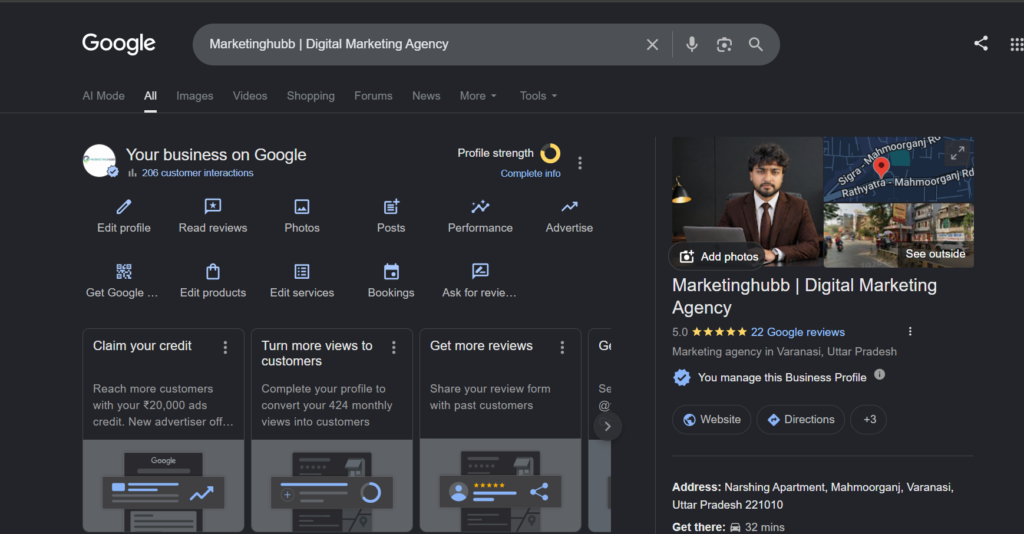
If I had to pick just one thing every hotel and restaurant in Varanasi must do this month, it would be this: fully optimise your Google Business Profile (GBP), previously known as Google My Business.
This is completely free, and it is often the very first thing a potential customer sees.
Google Business Profile Optimisation Checklist
- Correct business name (no keyword stuffing in the name, Google penalises this)
- Accurate category (e.g., “Hotel,” “North Indian Restaurant,” “Guest House”)
- Correct address and pin location
- Working phone number and WhatsApp link
- Business hours updated, including holidays
- High quality photos — rooms, food, exterior, staff
- Regular posts (offers, events, festival specials)
- Q&A section answered proactively
- Services and menu added directly on the listing
- Reviews responded to, both positive and negative
A well-optimised GBP profile alone can bring a steady stream of calls and enquiries without spending on ads. I have personally seen restaurants in Varanasi triple their walk-ins in two to three months purely by fixing photos, categories, and posting weekly updates.
Customer Reviews: The New Word-of-Mouth
In a city like Varanasi, where trust and reputation matter deeply (especially with religious tourism and pilgrimage visitors), customer reviews act as digital word-of-mouth. A tourist deciding between two similar hotels will almost always pick the one with more recent, genuine, and detailed reviews.
Why Reviews Matter So Much
- They build trust before the first interaction
- They directly influence your local search ranking
- They give you honest feedback to improve service
- They provide fresh, unique content that Google values
How to Get More Genuine Reviews
- Ask happy guests directly at checkout or after their meal
- Send a simple WhatsApp message with a direct review link
- Train staff to politely request reviews — this works better than you think
- Respond to every review, good or bad, professionally
- Never buy fake reviews — Google can detect patterns and this can get your listing suspended
Sample Response to a Negative Review
“Thank you for sharing your experience. We are sorry the room service was delayed during your stay. We have already spoken to our team to avoid this in future. We would love another chance to host you and make it right.”
This kind of response shows future customers that you care and take feedback seriously — it often builds more trust than a page full of five-star reviews with no responses at all.
Schema Markup: Helping Google Understand Your Business
Schema markup is a piece of code added to your website that helps Google understand exactly what your business is, without guessing. Think of it as giving Google a clear, labeled form instead of making it read through paragraphs to figure out your business type, address, and offerings.
Types of Schema Useful for Hotels and Restaurants
- LocalBusiness / Hotel Schema — tells Google your business type, address, and contact details
- Restaurant Schema — includes menu, cuisine type, price range, opening hours
- Review Schema — allows star ratings to appear directly in search results
- FAQ Schema — displays your frequently asked questions directly on the search page
- Breadcrumb Schema — helps Google understand your website structure
Why This Matters Practically
When schema markup is added correctly, your listing can show star ratings, price range, and opening hours directly on the Google search page — before the user even clicks. This increases click-through rate significantly, because your listing simply looks more complete and trustworthy compared to competitors without schema.
We handle schema implementation for all our hospitality clients at Marketing Hubb because this small technical step often gets ignored, yet it has a real, measurable impact on visibility.
Content Marketing That Brings Organic Traffic
Organic traffic means visitors who find you naturally through search, without you paying for ads. This is the most sustainable, long-term source of customers, and content marketing is how you build it.
Content Ideas for Hotels
- “Top 10 Places to Visit Near [Your Hotel Name] in Varanasi”
- “Best Time to Watch Ganga Aarti From Our Hotel”
- “A Complete Guide to Visiting Kashi Vishwanath Temple”
- “How to Reach Our Hotel From Varanasi Airport”
Content Ideas for Restaurants
- “Top 5 Must-Try Dishes at Our Restaurant”
- “Best Places to Eat Near Assi Ghat”
- “Our Chef’s Special Recipe Story”
- “How We Source Fresh Ingredients Locally”
This kind of content answers real questions people are searching for, while naturally introducing your business. Over time, this builds what is called topical authority — Google starts recognising your website as a genuine, helpful source on hospitality and travel in Varanasi, which improves rankings across all your pages, not just one.
Social Media Strategy for Hotels and Restaurants
Social media, especially Instagram and Facebook, works differently from SEO — it is more about building recognition and trust, and it often influences the decision even when the actual booking happens through Google or a call.
What Actually Works
- Short reels of Ganga Aarti view from your rooftop or rooms
- Behind-the-scenes kitchen videos for restaurants
- Guest testimonials shared as stories
- Festival specific posts (Dev Deepawali, Holi, Diwali specials)
- Local collaborations with Varanasi travel bloggers and food vloggers
What Does Not Work
- Posting only promotional “Book Now” content repeatedly
- Buying followers (this actually hurts engagement rate)
- Ignoring comments and DMs
- Inconsistent posting (once a month does not build trust)
Consistency matters more than perfection here. A simple phone-shot video of the Ganga Aarti view from your hotel terrace, posted regularly, often performs better than a highly polished ad that looks disconnected from reality.
Paid Advertising: When and How to Use It
Organic strategies take time to build. If you need faster results — for example, during wedding season or Dev Deepawali when demand is high — paid advertising through Google Ads and Meta Ads can help.
Google Ads for Hotels and Restaurants
- Search ads targeting “hotel near Assi Ghat” type keywords
- Location targeting set specifically to Varanasi and surrounding areas
- Call-only ads that let users tap to call directly from search results
Meta Ads (Facebook & Instagram)
- Retargeting website visitors who did not book
- Promoting offers to people who searched travel content near Varanasi
- Boosting high performing organic posts
Important note: Paid ads should support your organic strategy, not replace it. Many businesses stop appearing the moment they stop paying for ads. A strong SEO and content foundation means you keep getting visitors even during months you are not running ads.
A Real Case Study From Varanasi
Let me share a simplified example based on the pattern we have seen work repeatedly with hospitality clients.
The Situation: A mid-sized restaurant near Sigra had a decent location but almost no online presence. Their Google Business Profile had outdated photos, only 12 reviews, and no website.
What We Did (Over 90 Days):
- Set up and fully optimised their Google Business Profile with correct category, updated photos, and complete menu
- Built a simple, fast, mobile friendly website with online enquiry and WhatsApp button
- Added Restaurant and FAQ schema markup
- Ran a genuine review collection process — asking happy customers directly
- Published 6 local blog posts targeting Varanasi-specific searches
- Posted consistently on Instagram with short food and ambience reels
The Result: Within three months, their Google reviews grew from 12 to over 90, their Google Business Profile views increased significantly, and weekday footfall improved noticeably — especially during lunch hours, which had previously been their weakest time slot.
This is not an overnight result, and I want to be honest about that. A proper digital marketing strategy for hotels and restaurants is a consistent, month-on-month process — but the results compound over time.
Common Mistakes Hotels and Restaurants Make Online
- Ignoring Google Business Profile — treating it as a one-time setup instead of an ongoing tool
- Using low quality or outdated photos — this is often the first thing guests judge
- Not responding to reviews — especially negative ones, which signals poor customer care
- Having a slow, non-mobile-friendly website — losing customers before they even see the offer
- Copying content from competitors — this can actually hurt your SEO due to duplicate content issues
- Buying fake followers or reviews — short term boost, long term damage to trust and rankings
- Inconsistent posting — starting strong and then going silent for months
- Not tracking what is working — spending money on ads or content without checking actual results
These mistakes are exactly why so many hotels and restaurants feel their online presence “isn’t working” — the real issue is usually the absence of a proper digital marketing strategy for hotels and restaurants, not the effort itself.
Step-by-Step 90 Day Action Plan
Month 1: Foundation
- Optimise Google Business Profile completely
- Build or fix your mobile friendly website
- Add basic schema markup
- Start collecting reviews from current guests
Month 2: Visibility
- Publish 4-6 local blog posts targeting Varanasi keywords
- Start consistent social media posting (3-4 times a week)
- Set up Google Ads for high-intent local keywords
Month 3: Growth & Optimisation
- Analyse which keywords and pages are getting traffic
- Double down on what is working
- Expand content to cover more local landmarks and events
- Build local backlinks (tourism blogs, local directories, news mentions)
Checklist Before You Launch Your Strategy
- Mobile friendly, fast loading website
- Google Business Profile fully completed and verified
- Local keywords naturally used across website
- Schema markup added (LocalBusiness, Restaurant/Hotel, FAQ, Review)
- Review collection process in place
- Location-based content covering Varanasi landmarks
- Social media profiles active and consistent
- Click-to-call and WhatsApp buttons working
- Analytics and tracking set up to measure results
How Marketing Hubb Can Help You
Our Digital Marketing Strategy for Hotels and Restaurants
At Marketing Hubb, we work specifically with small businesses, hotels, restaurants, educational institutes, hospitals, and local service providers in Varanasi and surrounding areas. We understand this city — its neighbourhoods, its seasonal tourism patterns, and the kind of customers who search for local businesses here.
We do not believe in generic, copy-paste digital marketing packages. Our digital marketing strategy for hotels and restaurants is built around your actual business, your actual location, and your actual customers — not a one-size-fits-all template.
If you run a hotel, restaurant, or hospitality business in Varanasi and want a digital marketing strategy that brings real bookings and real customers — not just numbers on a dashboard — Marketing Hubb is here to help you build that, step by step.
You can reach out to us through our website at marketinghubb.in for a free consultation on where your business currently stands online and what needs to be fixed first.
Key Takeaways
- Search intent decides what kind of content and keywords you need — informational, commercial, and transactional
- A mobile friendly website is no longer optional; it is the first impression for most customers
- Google Business Profile is one of the highest ROI tools available, completely free
- Genuine customer reviews directly influence both trust and local rankings
- Schema markup helps your listing stand out with ratings, hours, and menu directly in search results
- Location-based SEO using specific Varanasi landmarks beats generic city-only targeting
- Consistency across website, social media, and reviews matters more than short bursts of activity
- Paid ads work best when supporting a strong organic foundation, not replacing it
Conclusion
A strong digital marketing strategy for hotels and restaurants is not about doing everything at once — it is about doing the right things consistently. Start with your Google Business Profile and website, build genuine reviews, use local keywords the way real people search, and add proper schema markup so Google can showcase your business fully.
Varanasi’s tourism and local dining scene is growing every year, and the businesses that show up correctly online — mobile friendly, well reviewed, and locally optimised — are the ones winning the bookings and the tables. If you are ready to build this the right way, Marketing Hubb is ready to help you get there.
Image SEO Suggestions
| # | Image File Name | ALT Text | Image Caption |
|---|---|---|---|
| 1 | digital-marketing-strategy-hotels-restaurants.jpg | digital marketing strategy for hotels and restaurants | How Marketing Hubb builds a digital marketing strategy for hotels and restaurants in Varanasi |
| 2 | hotel-ganga-view-varanasi-room.jpg | Hotel room with Ganga view near Assi Ghat Varanasi | A cozy hotel room with a stunning Ganga view near Assi Ghat |
| 3 | restaurant-near-godowlia-varanasi.jpg | Popular restaurant near Godowlia Varanasi interior | Warm interiors of a family-friendly restaurant near Godowlia |
| 4 | mobile-friendly-website-hotel-varanasi.jpg | Mobile friendly website design for Varanasi hotel | A fast, easy-to-use mobile website designed for local hotels |
| 5 | google-business-profile-restaurant-varanasi.jpg | Google Business Profile optimisation for restaurant in Varanasi | Optimised Google Business Profile showing menu and reviews |
| 6 | customer-review-hotel-varanasi.jpg | Guest leaving a review for hotel in Varanasi | A happy guest sharing a genuine review after their stay |
| 7 | schema-markup-hotel-website.jpg | Schema markup code for hotel website Varanasi | Schema markup helping search engines understand hotel details |
| 8 | local-seo-varanasi-map.jpg | Local SEO map showing hotels near Kashi Vishwanath temple | Google Maps view highlighting hotels near Kashi Vishwanath temple |
| 9 | marketing-hubb-team-varanasi.jpg | Marketing Hubb digital marketing team Varanasi | The Marketing Hubb team working on a local business strategy |
FAQs
1. What is the best digital marketing strategy for hotels and restaurants in Varanasi? The best digital marketing strategy for hotels and restaurants combines a mobile friendly website, an optimised Google Business Profile, local keyword targeting, genuine customer reviews, and schema markup — all working together rather than in isolation.
2. How can restaurants in Varanasi get more customers through Google? By optimising their Google Business Profile with accurate menu, photos and hours, collecting genuine reviews consistently, and using location-based keywords like “restaurant near Assi Ghat” on their website.
3. Why is a mobile friendly website important for hotels? Because most guests search and book from their phones. A slow or hard-to-use mobile site causes potential guests to leave and book with a competitor instead.
4. What is schema markup and why does my restaurant need it? Schema markup is code that helps Google understand your business details clearly, allowing your listing to show ratings, menu, and hours directly in search results, which increases clicks.
5. How do I get more genuine Google reviews for my hotel? Ask guests directly at checkout, send a simple WhatsApp link after their stay, and train staff to request feedback politely. Avoid buying fake reviews, as this can get your listing penalised.
6. What are local keywords and how do I find them for my business? Local keywords are search phrases that include your area or landmark, such as “hotel near Kashi Vishwanath temple.” You can find these using Google’s autocomplete suggestions and by checking what competitors rank for.
7. How long does it take to see results from local SEO? Typically, noticeable improvements start within 60 to 90 days of consistent effort, though this can vary based on competition and how complete your current online presence is.
8. Should hotels in Varanasi use Google Ads or focus only on SEO? Both work well together. SEO builds long-term, sustainable traffic, while Google Ads can bring quicker results during peak seasons like Dev Deepawali or wedding season.
9. What should be included on a hotel website homepage? Clear room details, pricing indication, high quality photos, location with map, click-to-call and WhatsApp buttons, and a simple booking or enquiry form.
10. How does location-based SEO help restaurants specifically? It helps your restaurant show up when people search for nearby landmarks, such as “restaurant near Godowlia,” rather than only generic searches like “restaurant in Varanasi.”
11. What is search intent and why does it matter for hospitality businesses? Search intent is the reason behind a search. Understanding whether someone is researching, comparing, or ready to book helps you create the right content to capture them at each stage.
12. How often should a restaurant post on social media? Ideally 3-4 times a week, focusing on real photos and short videos rather than only promotional posts, to build genuine engagement and trust.
13. Can small restaurants really compete with bigger chains online? Yes, especially through local SEO and Google Business Profile optimisation, since Google often prioritises relevance and proximity over brand size for local searches.
14. What is the role of Marketing Hubb in helping local businesses in Varanasi? Marketing Hubb builds customised digital marketing strategies for hotels, restaurants, and other local businesses in Varanasi, covering website development, local SEO, Google Business Profile management, and reputation building.
15. How do I measure if my digital marketing strategy is actually working? Track metrics like Google Business Profile views and calls, website traffic and enquiry form submissions, review count and rating trend, and actual booking or footfall increase month over month.