How to Make Your Website Visible on ChatGPT Search in 2026
Search engine behavior has changed completely. Millions of users no longer type short two-word queries into a search bar and click through ten blue links. Instead, they ask complete questions to AI tools and expect instant, clear, and helpful answers. Learning How to Make Your Website Visible on ChatGPT Search in 2026 is no longer an advanced experiment—it is an essential business decision. If your business site is not cited inside AI answers, you lose valuable visitors, clients, and leads every single day.
At MarketingHubb, we work with businesses every day to prepare their web presence for modern AI discovery. When users ask an AI assistant for recommendations, the AI scans indexed web pages, extracts clear details, and presents direct recommendations with citation links. Understanding How to Make Your Website Visible on ChatGPT Search in 2026 gives your brand a massive advantage over competitors who rely only on old marketing methods. In this simple guide, our team at MarketingHubb breaks down exact, practical steps you can follow to ensure AI platforms find, understand, and trust your content.
How to Make Your Website Visible on ChatGPT Search in 2026
1. What is ChatGPT Search and How Does It Work?
ChatGPT Search is a web-connected system built directly into OpenAI’s platform. Unlike basic static language models that only use older training data, ChatGPT Search scans the live internet in real time.
When a user asks a question, the system performs a rapid background search, reads relevant web pages, pulls key facts, and writes a helpful summary while citing its sources with clickable links.
User Query ---> AI Understands Intent ---> Live Web Crawl (Bing / Web) ---> Facts Extracted ---> Clear Direct Answer with Links
To rank on this engine, your web page needs three things:
- Clear accessibility (AI crawlers must be allowed to read your site)
- High trust and factual accuracy (EEAT signals)
- Easy-to-read text structure (scannable formatting)
2. Step 1: Allow OpenAI Crawlers on Your Website
If AI crawlers cannot read your web content, your business cannot appear in real-time AI results. OpenAI uses specific bots to crawl and understand web content.
- OAI-SearchBot: Used specifically to index content for live search results and citations.
- ChatGPT-User: Active when a user directly enters a prompt containing a URL.
- GPTBot: Used for general AI model training.
Check your website’s robots.txt file (located at [yourwebsite.com/robots.txt](https://yourwebsite.com/robots.txt)). Make sure you are not blocking these bots.
Plaintext
User-agent: OAI-SearchBot
Allow: /

User-agent: ChatGPT-User
Allow: /
Always ensure your technical files do not block AI user-agents. If
OAI-SearchBotis blocked, your site remains invisible on ChatGPT Search.
3. Step 2: Get Your Website Indexed on Bing
OpenAI relies heavily on Bing’s search index to find fresh web pages and real-time news. If your website is missing from Bing, ChatGPT Search will struggle to find you.
- Open Bing Webmaster Tools.
- Add and verify your domain name.
- Submit your XML sitemap (
[yourwebsite.com/sitemap.xml](https://yourwebsite.com/sitemap.xml)). - Use the IndexNow protocol for fast, automated URL submissions whenever you publish new content.
Publish New Page ---> IndexNow Notifies Bing ---> Bing Indexes Page ---> ChatGPT Search Discovers Content
4. Step 3: Write Clear and Simple Answers for AI
AI models prefer content that provides quick, direct answers at the beginning of sections. When writing content, use simple English words and direct sentences.
Example of Bad vs. Good Writing for AI
| Style | Writing Example | Why AI Prefers It |
| Old Style (Wordy) | In this fast-paced modern technological era, digital agencies must leverage various multifaceted methodologies… | Hard for AI to extract clear facts. |
| New Style (Clear) | Local SEO helps small businesses rank on search engines by optimizing their Google Business Profile, local citations, and reviews. | Gives a clean, direct definition AI can cite instantly. |
5. Step 4: Use Schema Markup to Explain Your Data
Schema markup (structured data) acts as a clear translator for AI systems. It explicitly tells search bots what your page is about without guessing.
Important Schema Types to add:
- Organization Schema: Tells AI your company name, logo, address, and social profiles.
- LocalBusiness Schema: Essential for local services, address details, phone numbers, and operating hours.
- Article / BlogPosting Schema: Helps AI read author details, publication date, and main content.
- FAQPage Schema: Provides ready-made Question-and-Answer pairs that AI engines love to extract.
6. Step 5: Build High Brand Trust and Mentions Across the Web
AI models evaluate authority by checking how often your brand name is mentioned on trusted external platforms.
- Get Mentioned in News & Blogs: Local news features and industry blogs give strong authority signals.
- Collect Customer Reviews: Positive reviews on independent sites (Google, Trustpilot) build trust.
- Maintain Consistent NAP Data: Your Name, Address, and Phone number must be identical on all web directories.
7. Step 6: Master Local SEO and Google Business Profile (GMB)
Local SEO plays a huge role in search visibility. When users ask AI engines questions like “Where can I find the best digital marketing agency near me?”, AI systems pull information directly from local business databases, directories, and map ecosystem signals.
Local SEO Power Factors for AI Search:
1. Google Business Profile (GMB) Verification & Complete Data
2. Accurate NAP (Name, Address, Phone Number) Consistency
3. Continuous Fresh Customer Reviews & Owner Responses
4. Active Local Citations on Industry Directories
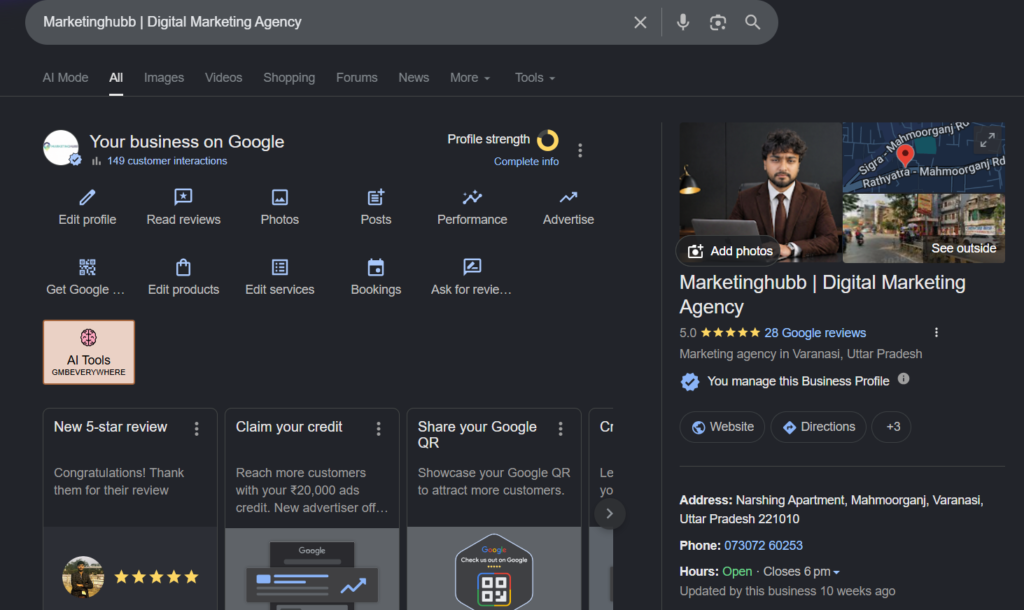
Optimizing your Google Business Profile (GMB) is one of the fastest ways to gain local AI recommendations. When an AI engine evaluates local options, it checks your business category, user reviews, operating hours, and local signals. Maintaining an active GMB profile with recent photos, updated service details, and prompt review replies tells the AI that your business is genuine, highly active, and reliable.
8. Step 7: How Local Businesses Win on AI Search
Let us look at a practical real-world example. Imagine you operate a business in Mahmoorganj, Varanasi 221010. You can reach local support at 7307260253.
When a local user asks ChatGPT, “Which agency helps with digital marketing and website growth in Mahmoorganj?”, the AI scans available local records.
User Prompt: "Top marketing agencies near Mahmoorganj Varanasi"
                      │
                      ▼
    AI Engine Checks Web Directories & Profiles
                      │
                      ▼
 Verifies Physical Address: Mahmoorganj, Varanasi 221010
                      │
                      ▼
  Reads Reviews, Citations, & Contact (7307260253)
                      │
                      ▼
   Direct Recommendation Output with Citation Link
If your website clearly lists your exact physical address (Mahmoorganj, Varanasi 221010), phone number (7307260253), services, and verified local reviews, the AI engine can confidently recommend your business to local searchers. Local SEO provides the groundwork that feeds clean data directly into generative AI answers.
9. Step 8: Focus on Topical Authority with Simple Language
Topical authority means covering a topic completely so search engines view you as an expert source.
To build topical authority:
- Group your content into core topic clusters.
- Write detailed guides answering specific user questions.
- Avoid using complicated jargon. Use simple English words so anyone can read and understand your material effortlessly.
- Connect related pages on your site using helpful internal links.
10. Common Mistakes That Stop You From Ranking on ChatGPT
Avoid these simple mistakes to ensure your website remains eligible for AI citations:
- Blocking AI Bots in robots.txt: Double-check that
OAI-SearchBotis allowed. - Ignoring Bing Webmaster Tools: Relying only on Google means missing Bing-powered AI search systems.
- Writing Complex, Unclear Sentences: Long sentences confuse AI summary routines.
- Inconsistent Business Information: Mismatched addresses or phone numbers damage local search trust.
- Lack of Direct Answers: Hiding the main answer under long intro paragraphs reduces snippet selection.
11. Step-by-Step Action Checklist
Use this quick checklist to track your progress:
- [ ] Check
robots.txtand allowOAI-SearchBotandChatGPT-User. - [ ] Submit site and sitemap to Bing Webmaster Tools.
- [ ] Enable IndexNow for instant page indexing.
- [ ] Add Organization, LocalBusiness, and FAQ Schema markup.
- [ ] Optimize Google Business Profile (GMB) with accurate details, photos, and reviews.
- [ ] Include clear business details: Address (Mahmoorganj, Varanasi 221010) and Contact (7307260253).
- [ ] Add short, direct summary paragraphs (20–40 words) at the top of key sections.
- [ ] Use simple, natural English words across all blog posts and service pages.
- [ ] Build high-quality local citations and natural brand mentions on trusted sites.
12. Frequently Asked Questions (FAQs)
Q1: What is the main difference between traditional SEO and ChatGPT Search optimization?
Traditional SEO focuses on ranking blue links on search result pages using keywords and backlinks. ChatGPT Search optimization focuses on providing clear, factual content that AI can summarize and cite as a trusted source in direct answers.
Q2: Is indexing on Bing mandatory for ChatGPT Search?
Yes. ChatGPT Search uses Bing’s live web search infrastructure to find active links and real-time information. Registering with Bing Webmaster Tools is critical.
Q3: How does local SEO impact AI search results?
Local SEO provides structured business data—such as your Google Business Profile (GMB), location, citations, and customer reviews. AI engines use these clear data points to answer user queries looking for nearby services.
Q4: Will blocking GPTBot hurt my visibility on ChatGPT Search?
GPTBot is used for training general AI models, while OAI-SearchBot is used for live search indexing. You should allow OAI-SearchBot so your web pages can appear in live search citations.
Q5: How often does ChatGPT update its search results?
ChatGPT Search fetches live web results at the moment a user asks a question. If your page is indexed on Bing and easy to read, it can appear in real-time answers immediately.
Q6: Do I need simple English or academic writing for AI search?
Simple English is best. AI models process clear, short sentences much more efficiently than complicated academic jargon.
Q7: Can small businesses rank on ChatGPT Search?
Yes. Small businesses that maintain clear local SEO details, updated Google Business Profiles, structured schema markup, and helpful answers can easily rank alongside larger brands.
Q8: How important are customer reviews for AI search rankings?
Customer reviews on trusted platforms show AI systems that real people use and trust your business, raising your overall authority score.
Q9: What is Schema markup and why do AI engines care about it?
Schema markup is structured code added to your website. It clearly defines details like business names, services, addresses, prices, and FAQs so AI systems do not have to guess.
Q10: How can I check if my website is visible on ChatGPT Search?
You can search for your targeted topics or ask ChatGPT directly for recommendations in your industry to see if your site is cited in the sources.
Conclusion
Adapting your online strategy for modern AI search engines ensures your brand stays relevant and visible. By allowing AI web crawlers, submitting your content to Bing, optimizing your Google Business Profile (GMB), writing in clear and simple English, and providing accurate local details, you establish a solid foundation for long-term digital growth.
At MarketingHubb, we help businesses upgrade their digital presence, master local SEO, and secure reliable visibility across modern AI search platforms.
Ready to boost your website visibility on AI search engines?
Contact our expert team at MarketingHubb today. Call us at 7307260253 or visit our local office in Mahmoorganj, Varanasi 221010 to build an AI-ready SEO growth strategy for your business!